Stop Doing Monk Mode Right Now: Why Slow Productivity Is The Only Real Way To Get Ahead
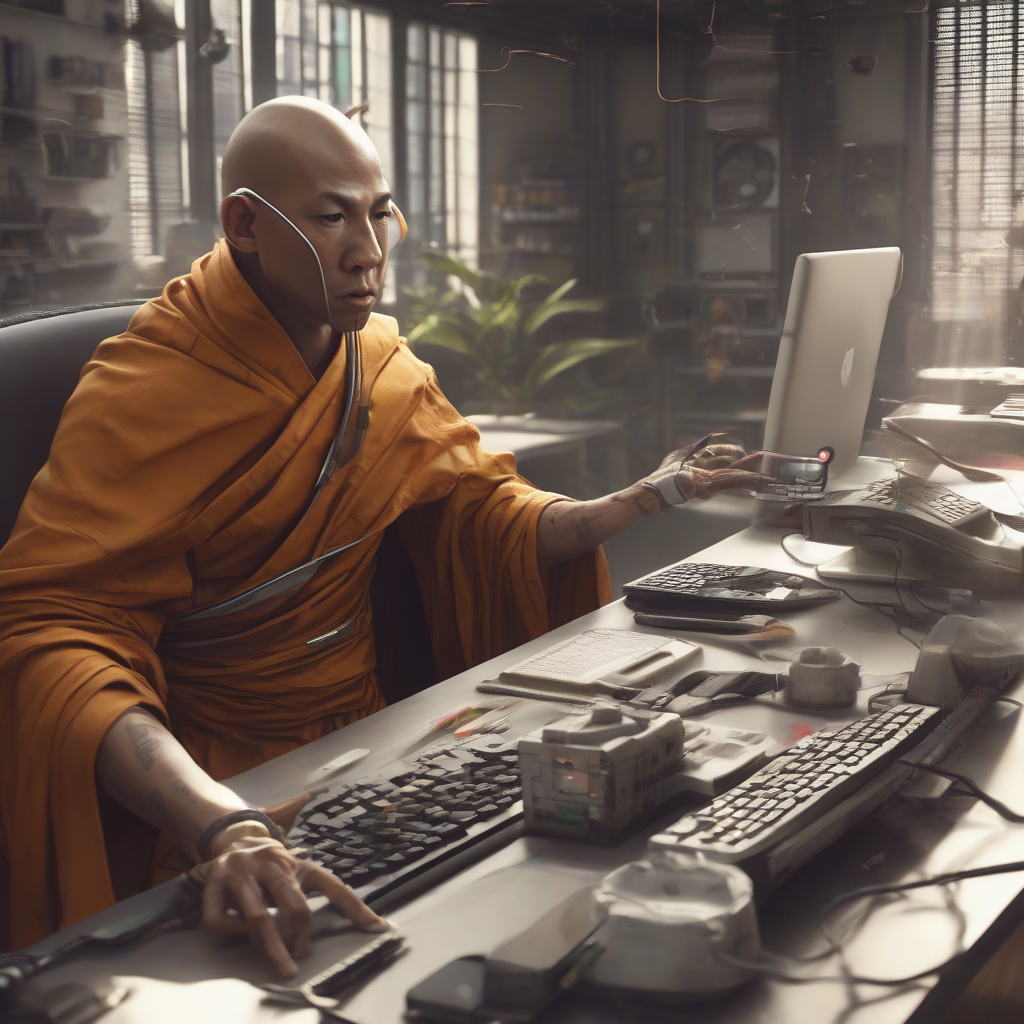
Monk Mode is just burnout with a better PR team.
You’ve seen the videos. The dark rooms. The 4:00 AM alarms. The "no-contact" rules. We’ve turned productivity into a monastic religion, and it’s making us worse at our jobs.
I’ve spent the last decade analyzing the habits of the top 1% of earners. I’ve studied the output of billionaire founders, elite creatives, and world-class engineers.
Here is the truth nobody wants to tell you: The people at the top aren't "grinding" in a dark room for 90 days straight. They are moving slower than you.
If you want to win the next decade, you need to stop sprinting. You need to embrace Slow Productivity.
The Performative Trap of Aesthetic Isolation
Monk Mode is LARPing.
It’s Live Action Role Play for people who want to feel like they are working without actually producing anything of value. It’s an aesthetic. It’s a "vibe."
You buy the black coffee, the Moleskine notebook, and the noise-canceling headphones. You delete Instagram for three weeks. You tell everyone you’re "going dark."
And then? You spend six hours a day "organizing" your Notion dashboard.
This is what I call the Dopamine of Motion. Motion is not action. Motion is researching, planning, and rearranging your desk. Action is the hard, uncomfortable work of creating something from nothing.
Monk Mode focuses on the quantity of hours spent in isolation. But the market doesn’t pay for hours. The market pays for value.
When you isolate yourself completely, you lose the "Creative Collision" necessary for high-level output. You become an echo chamber. You produce volume, but you lose the signal.
The most successful people I know have high "Surface Area." They are reachable. They are observing the world. They aren't hiding; they are filtering.
The Biological Math of the Rebound Effect
Human beings are not machines. We are biological systems.
When you push a system to its limit for 90 days, the system breaks. It’s basic physics.
Monk Mode relies on a "Sprint and Crash" cycle. You work 14-hour days for a month, fueled by caffeine and cortisol. You feel like a god. You think you’ve cracked the code.
Then, week five hits.
Your brain stops producing the focus chemicals. Your body demands the sleep you stole. You fall into a "Productivity Hangover" that lasts twice as long as the sprint.
You spend the next month "recovering" by doom-scrolling and missing deadlines.
If you look at your total output over a year, the "Sprint and Crash" method is actually less efficient than a steady, moderate pace.
- The Sprinter: 100% effort for 1 month, 10% effort for 2 months. Total output: 120 units.
- The Slow Producer: 60% effort for 3 months. Total output: 180 units.
Slow Productivity isn't about doing less. It’s about doing things at a pace that allows you to never stop. Consistency is the only force in the universe that compounds. You cannot compound if you are constantly resetting your momentum because of burnout.
The Power of "Do Fewer Things"
The secret to 10x results is not doing 10x more work. It’s doing one thing that is 10x more valuable.
Monk Mode encourages a "Checklist Mentality." You want to tick every box. You want to feel "busy."
Slow Productivity is built on three pillars, popularized by Cal Newport:
- Do fewer things.
- Work at a natural pace.
- Obsess over quality.
When you do fewer things, you have the "Cognitive Bandwidth" to actually solve hard problems.
If your calendar is packed with 12 separate tasks, your brain is constantly switching gears. This is "Context Switching," and it destroys your IQ. Studies show that switching between tasks can drop your effective IQ by 10 points.
Monk Mode often fills your day with "Pseudo-Work"—emails, Slack, minor tweaks, and low-level admin—just to stay in the "Zone."
Slow Productivity demands that you pick one high-leverage project and give it your best hours. You don't need a 12-hour workday. You need 3 hours of "Deep Work" followed by a long walk.
The walk is where the real work happens. It’s where your subconscious connects the dots. If you are always "grinding," your subconscious never gets a turn at the wheel.
Quality is the Only Moat Left
We are entering the era of AI-generated infinite volume.
If you try to compete on volume, you will be replaced. If you try to compete on speed, you will be replaced.
Monk Mode produces commodities. Slow Productivity produces masterpieces.
Think about the best books you’ve read, the best software you’ve used, or the best films you’ve watched. None of them were rushed. None of them were the result of a "30-day grind." They were the result of years of steady, patient, high-quality work.
The market is tired of "Fast Content" and "Fast Products." There is a massive, growing premium on things that took time to build.
When you move slowly, you have the time to be original. Speed forces you to rely on clichés. Patience allows you to find the "Third Way" of solving a problem.
The Prediction
In the next 36 months, we will see a massive "Cultural Correction" away from the Hustle Culture and Monk Mode aesthetics.
The "Winner" of the next decade won't be the person who worked the most hours. It will be the "Deep Specialist" who produced one or two world-class assets while working four hours a day and spending the rest of their time learning, resting, and connecting.
The "4-Hour Work Week" was a prophecy, but not about laziness. It was about the realization that high-value output is decoupled from time.
We are moving from the "Industrial Age" of productivity (hours = output) to the "Curation Age" (judgment = output).
And you cannot have good judgment when you are exhausted, isolated, and caffeinated to the point of tremors.
Stop trying to be a monk. Start trying to be a craftsman.
Get more sleep. Take more walks. Do less.
But make what you do undeniable.
What is the one project you would work on if you were forbidden from doing anything else for a month?