7 Shocking Reasons Open-Source AI is Destroying Big Tech’s Monopoly Right Now
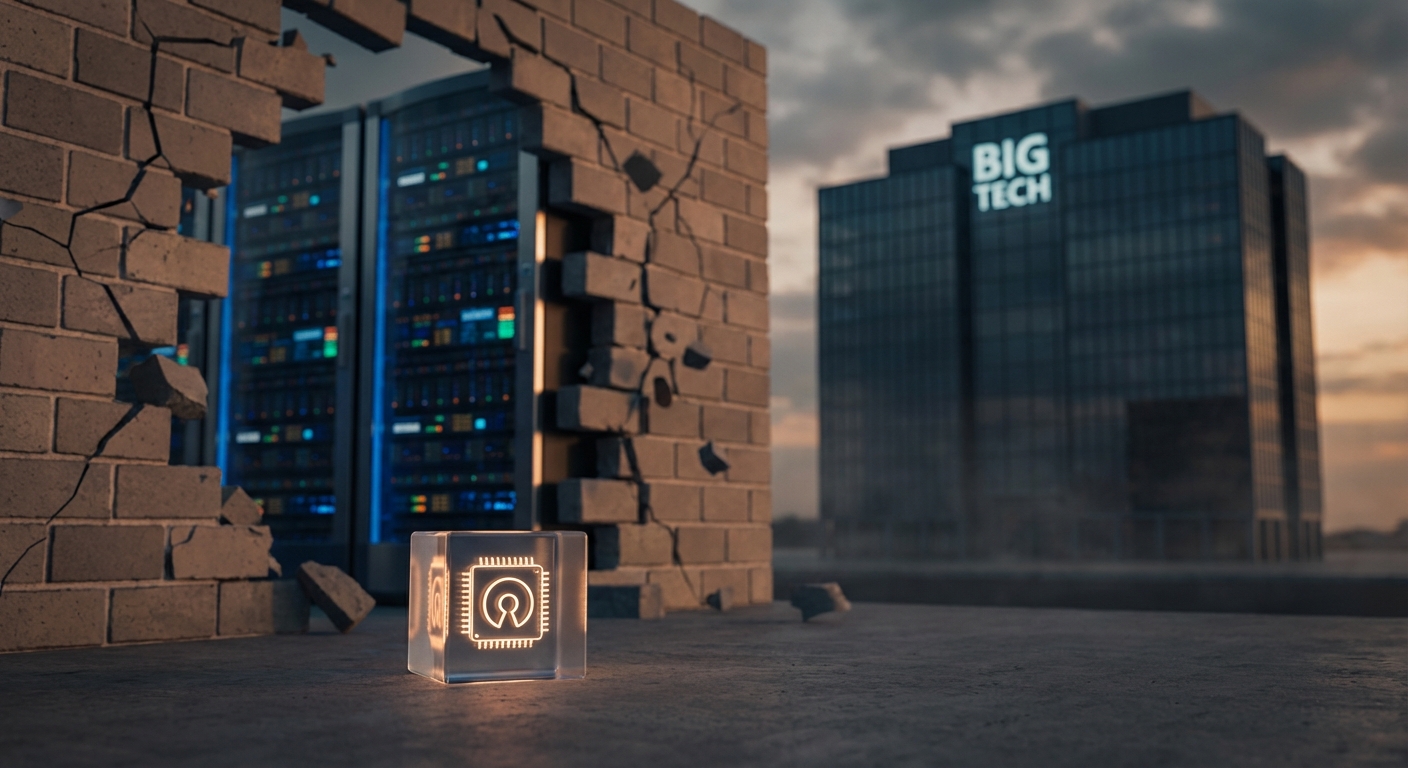
Silicon Valley wants you to believe that "bigger is better." They want you to believe that unless you have $10 billion in H100 clusters, you aren't in the game. They are wrong.
The gatekeepers are losing control. The moats are evaporating. The era of paying a monthly subscription to a "closed" god-model is ending before it even truly began.
I’ve spent the last six months analyzing the shift from proprietary giants to open-source rebels. Here is why the monopoly is dead.
1. The "No Moat" Reality
A leaked internal memo from Google last year said it best: "We have no moat, and neither does OpenAI."
Open-source models are closing the gap at a speed that is statistically impossible for a single corporation to match. When Meta released Llama, the world didn't just get a new tool. They got the blueprint. Within weeks, the open-source community had optimized those models to run on a MacBook. Then a phone. Then a Raspberry Pi.
2. The Sovereign Data Revolution
Fortune 500 companies are terrified of OpenAI.
They won’t tell you that in their PR releases, but look at their actions. Samsung, Apple, and JPMorgan have all restricted the use of ChatGPT. Why? Because when you feed your data into a closed model, you are training your future competitor.
The biggest companies in the world are pivoting to "Sovereign AI."
They are downloading open-source weights like Mistral or Llama and hosting them on their own private clouds. No data leaks. No API costs. No censorship from a 22-year-old safety engineer in San Francisco.
The landlords are winning.
3. The Quantization Miracle
Big Tech’s biggest lie is that you need a supercomputer to innovate.
Innovation is now happening through "Quantization"—the process of shrinking massive models so they can run on consumer hardware without losing intelligence.
We are seeing open-source contributors take models that originally required $300,000 worth of hardware and making them run on a $1,500 iPhone. This destroys the subscription model.
4. The Talent Exodus
The best engineers in the world no longer want to be cogs in the Google machine.
They want to build. They want to share. They want to be the ones who trigger the next 100,000-star repository on GitHub.
The "Brain Drain" from OpenAI, DeepMind, and Meta is accelerating. These engineers are leaving to start lean, open-weight companies. They realize that a team of 10 elite researchers can now produce a model that rivals a team of 1,000.
The leverage has shifted from the Corporation to the Individual.
We are entering the era of the "One-Person Unicorn." This is only possible because of open source. You can now pull a state-of-the-art LLM, a vector database, and a frontend framework—all for free—and build a product that generates millions.
The Insight
By 2026, the "Most Powerful AI" in the world will not be owned by a corporation.
The monopoly isn't just cracking. It’s gone.
Are you building on someone else's land, or are you finally ready to own your own intelligence?