The Hidden Truth About Hollywood’s Collapse: Why AI Is Making Traditional Film Crews Obsolete
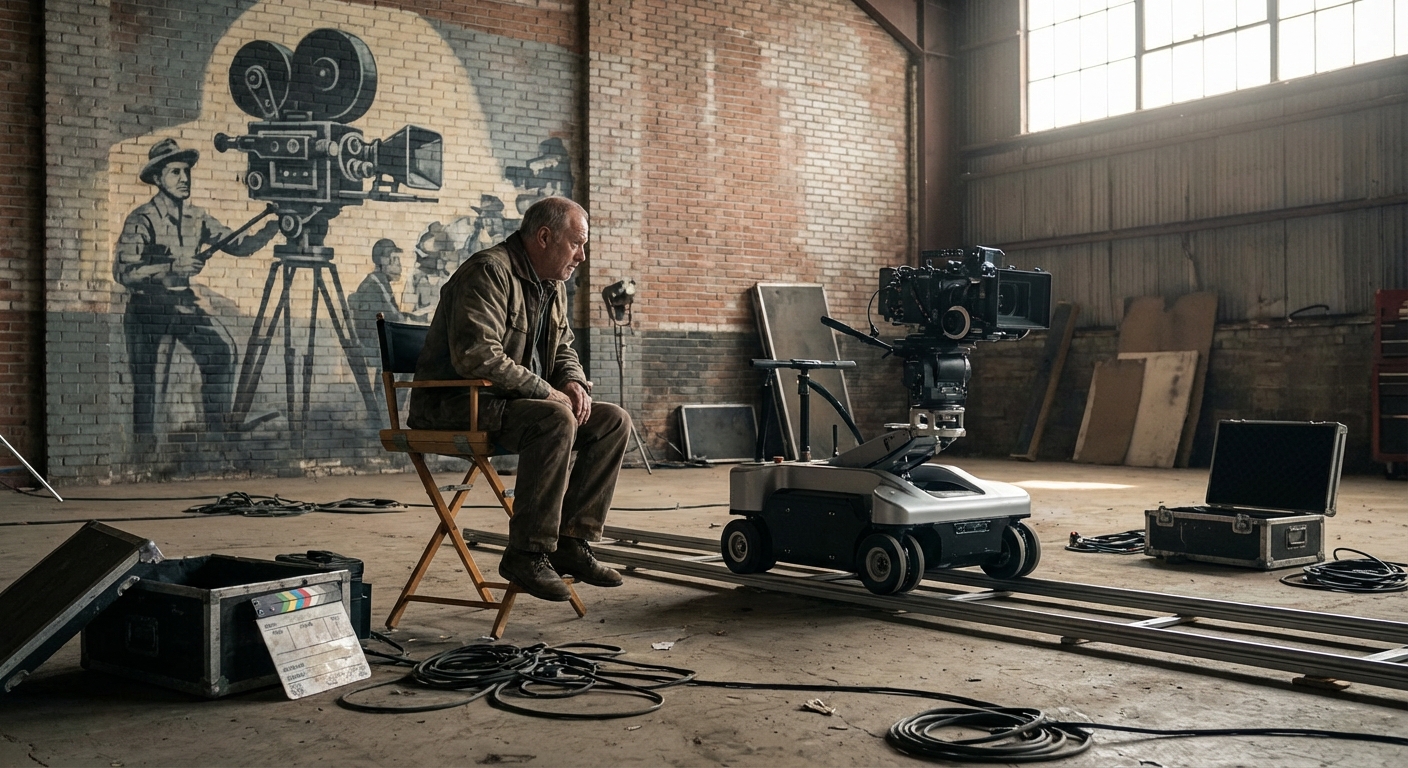
Hollywood didn’t die in a movie theater. It died on a GPU.
The industry is currently staring at a $100 billion cliff. Everyone in Los Angeles is whispering about it. Nobody is saying it out loud.
The era of the "Mega-Production" is over.
We are moving from a world where movies require 500 people to a world where they require five. If you think the recent strikes solved the problem, you aren't paying attention.
Here is the hidden truth about the collapse.
The Math of the $200 Million Mistake
The traditional Hollywood model is a bloated corpse.
Look at a standard blockbuster budget. $200 million. $30 million goes to the stars. $50 million goes to marketing. The rest? It goes to "The Machine."
We are talking about thousands of hotel rooms. Thousands of plane tickets. 5,000 meals served on plastic plates. Massive diesel generators idling in the desert for 14 hours a day just to keep a makeup trailer cool.
This is the "Legacy Tax."
For 100 years, the cost of entry to filmmaking was capital. You needed a studio. You needed a permit. You needed a union-mandated crew of 80 people just to move a single light fixture.
In the next 24 months, we will see the first $100 million "look" created for $100,000.
When the cost of high-end production drops by 99.9%, the gatekeepers lose their keys. The leverage shifts from the person who owns the studio to the person who owns the prompt.
The Disappearing Set
Traditional film crews are organized like 19th-century factories.
You have the Gaffer. The Key Grip. The Best Boy. The Script Supervisor. The Second Assistant Director. These are highly skilled, specialized roles. They are also roles designed to solve physical problems.
Lighting a scene is a physical problem. Moving a camera on a crane is a physical problem. Managing 300 extras in a crowd scene is a physical problem.
Generative video turns physical problems into compute problems.
Why hire 300 background actors when Sora or Runway can generate a photorealistic crowd with a single sentence? Why fly a crew of 60 to Iceland for a "perfect" sunrise when you can generate that exact lighting environment in a digital sandbox?
The "Set" is no longer a place you go. It is a file you open.
This isn't just about "special effects." This is about the fundamental DNA of a production. We are seeing the death of the "Middle-Tier Crew."
The industry will split in two. At the top, a handful of "Human-Only" prestige films (like organic produce). At the bottom, a massive, hyper-efficient wave of AI-native content that looks indistinguishable from Marvel.
The people in the middle—the journeyman editors, the lighting techs, the boom operators—are the "Hidden Truth" of this collapse. They are the ones being erased first.
The Rise of the Solo Studio
We are entering the age of the "Auteur 2.0."
In the 1990s, you needed a crew to make a movie. In the 2010s, you needed a crew to make a movie that looked "pro." In the 2020s, you just need a vision and a high-speed internet connection.
Think about the "Solo Creator."
Right now, a kid in a bedroom in Jakarta can write a script with Claude, generate the concept art with Midjourney, animate the scenes with Luma, and clone the voices with ElevenLabs.
The friction is gone.
The traditional studio system relied on a "Bottleneck of Talent." You had to go through the agency. You had to go through the guild. You had to play the game.
When everyone has access to a $100 million aesthetic, the "Look" becomes a commodity. What remains valuable? The idea. The hook. The taste.
Hollywood spent 80 years perfecting the "How." They are about to get destroyed by people who only care about the "Why."
The "Solo Studio" will produce more content in a week than a major network produces in a year. They will iterate faster. They will fail cheaper. And eventually, they will capture all the attention.
The Death of the Distribution Gatekeeper
Hollywood’s final line of defense was the "Pipe."
They owned the theaters. They owned the cable lines. They owned the streaming apps.
But the "Pipe" is leaking.
The average 19-year-old doesn't care about a Netflix premiere. They care about the creator they follow on TikTok or YouTube. They care about the community.
AI-driven production allows for "Personalized Cinema."
Imagine a world where you don't watch a movie; you order a movie. "I want a 90-minute neo-noir thriller set in 1920s Tokyo, starring a digital version of young Marlon Brando, with a soundtrack by Hans Zimmer."
The technology to do this is 5-7 years away.
When the audience can create their own blockbusters, the "Executive" becomes a vestigial organ. The "Greenlight" becomes a button on your phone.
The collapse isn't coming. It's already here. It’s just waiting for the rendering to finish.
The studios are currently trying to sue the future into staying in the past. It never works. You can't sue a tide. You can't copyright a revolution.
The Insight
By 2027, we will see a feature-length film reach #1 on a major global platform that was written, directed, and "shot" by a team of fewer than 5 people.
It will look better than anything currently on Disney+. It will cost less than the catering budget for a single episode of The Mandalorian.
The era of "The Crew" is being replaced by the era of "The Curator."
Technical skill is being outsourced to the machine. Artistic direction is the only remaining moat.
If your job on a film set involves "doing" rather than "deciding," you are in the crosshairs.
The Question
When the barrier to entry for a "Hollywood Blockbuster" is $0, will you be the person telling the machine what to build, or the person wondering why the lights went out?