5 Shocking Reasons Your AI Habits Use 10 Times More Energy Than You Think
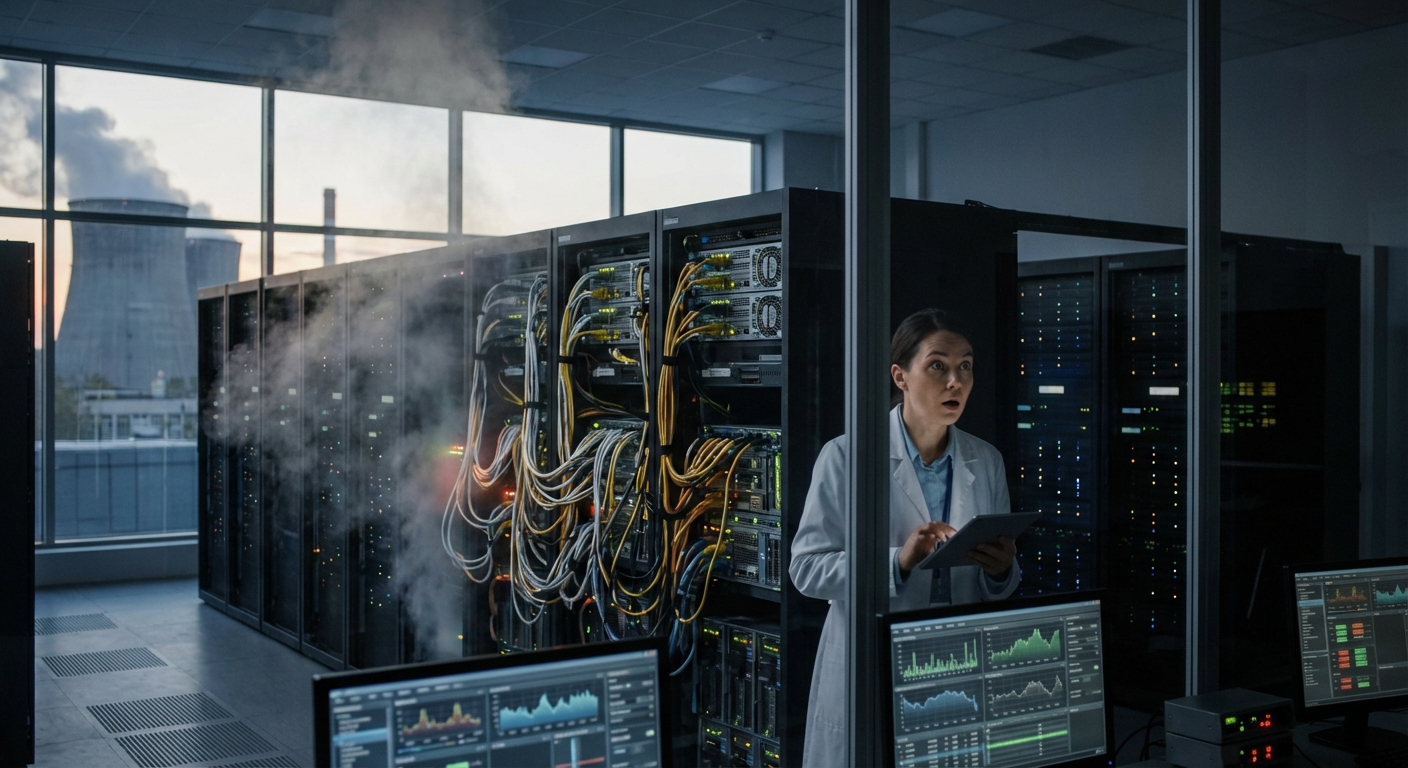
We’ve been sold a lie that the "Cloud" is weightless. We think our digital habits are clean because they don’t have a tailpipe. We are wrong.
1. The "Inference vs. Search" Math
When you search Google, you’re accessing an index. It’s a library. Google finds the page, hands it to you, and goes back to sleep. The energy cost is roughly 0.3 watt-hours.
When you prompt ChatGPT, the model isn’t "finding" information. It is creating it. It’s running billions of parameters through massive GPU clusters to predict the next token. Every. Single. Word.
A single GPT-4 query consumes roughly 10 times the electricity of a Google search.
We aren't just searching anymore. We are generating digital matter out of thin air, and the "electricity bill" for that creation is staggering.
2. The Invisible Cooling Tax
Data centers are the world’s most expensive radiators.
When NVIDIA H100 chips run at full capacity, they get hot. Dangerously hot. To keep them from melting, data centers have to pump in millions of gallons of water or run massive industrial air conditioning units 24/7.
This is the "Hidden Tax."
Researchers found that training GPT-3 in Microsoft’s state-of-the-art data centers directly consumed 700,000 liters of clean freshwater. That’s enough to produce 370 BMW cars.
And that was just the training.
Every time you have a "casual chat" with an AI, you are triggering a cooling system that uses more water than a dozen toilet flushes. We are trading our cooling resources for better email subject lines.
3. The Sledgehammer Effect (Model Overkill)
You are using a sledgehammer to crack a nut.
90% of users use GPT-4 or Claude 3.5 Sonnet for tasks that a calculator could do. You ask a 1.7-trillion parameter model to "Summarize this 200-word email."
That is energy malpractice.
It’s like hiring a Boeing 747 to deliver a pizza across the street. The sheer amount of "compute overhead" required to wake up a top-tier LLM is massive. Even if the task is simple, the entire neural network (or a significant MoE slice) has to activate.
We have become "Model Lazy."
Because the interface is the same, we don't realize that a "complex" prompt and a "simple" prompt both trigger a high-energy event. We are burning through the grid because we refuse to use smaller, specialized models for basic tasks.
4. The Endless Iteration Loop
The "10x" energy spike doesn't just come from one prompt. It comes from the "Refinement Loop."
In the old world, you wrote a draft. You used your brain. Energy cost: A sandwich.
Each of those 50 iterations uses the same peak energy as the first. This "Infinite Prompting" behavior has created a feedback loop where we use 5,000% more compute power to produce the same result we used to get with 15 minutes of focused thinking.
We aren't becoming more efficient. We are just outsourcing our "trial and error" to the power grid.
5. The Hardware Replacement Death-Spiral
The chips required for AI—NVIDIA’s GPUs—are the most complex pieces of silicon ever manufactured. The energy required to mine the rare earth minerals, refine them, and manufacture these chips is astronomical.
We are building massive, energy-intensive infrastructure that we tear down and replace almost immediately to stay competitive. This creates a cycle of "e-waste" and "manufacturing energy" that is never factored into your "Carbon Neutral" subscription.
The Insight
The era of "Free Compute" is ending.
In the next 24 months, I predict we will see the birth of the "Energy-Label Era."
We will see a massive shift toward "Local AI"—small models that live on your phone and use 99% less energy than the cloud giants. "Big AI" will become a luxury good, reserved for scientific breakthroughs, not for writing your LinkedIn updates.
Efficiency will become the new "Cool."
The winners won't be the people using the biggest models. The winners will be the people who get the best results with the least amount of compute.
The CTA