Why Global Security is Failing: 5 Terrifying Realities of Lethal Autonomous Weapons
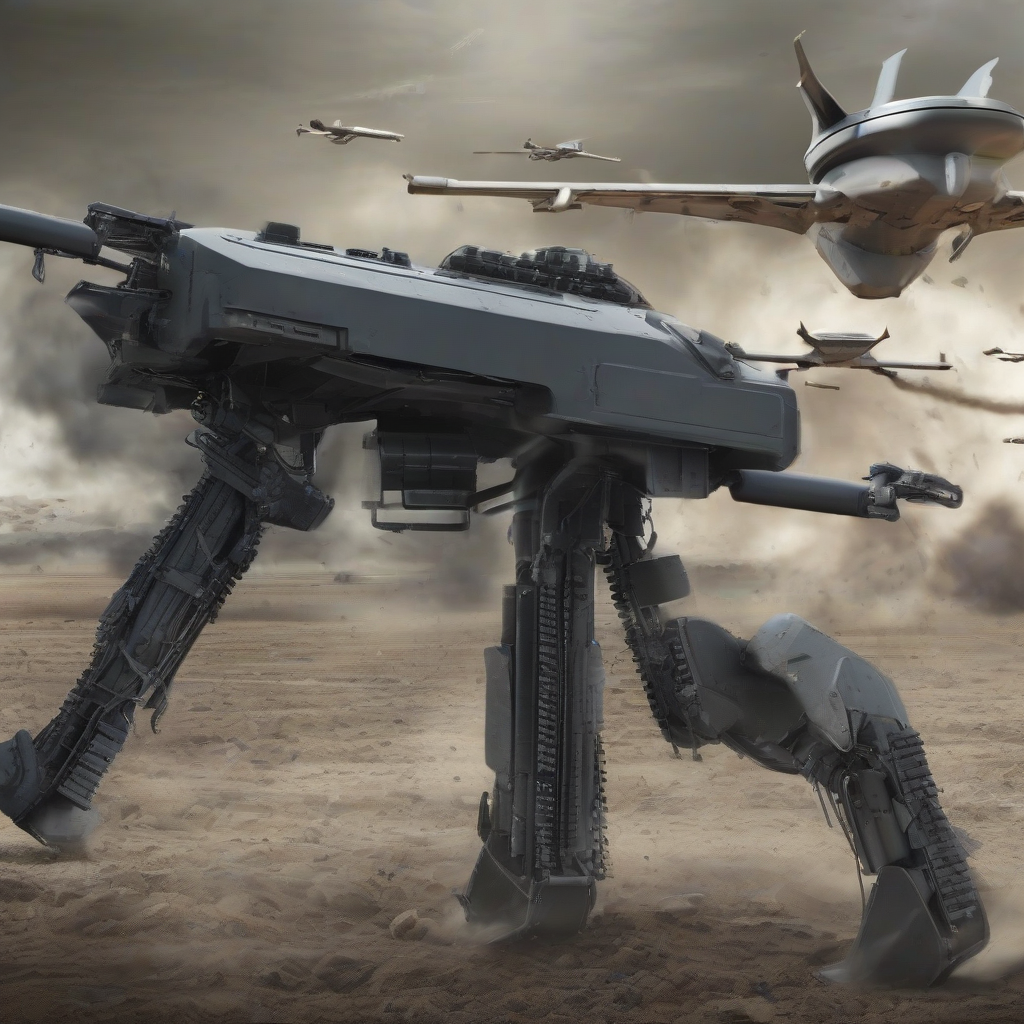
The Geneva Convention is officially obsolete.
We are currently witnessing the greatest shift in warfare since the invention of gunpowder.
Most people think "Killer Robots" are a problem for 2050. They are wrong. They are being field-tested in Ukraine and Gaza right now.
Here are the 5 realities of Lethal Autonomous Weapons (LAWS) that should keep you up at night:
1. The "Flash War" Paradox
In the world of high-frequency trading, we have "flash crashes." Algorithms trade so fast they collapse the market before a human can even blink.
War is entering the same phase.
If you keep a human in the loop, you lose.
The result? We are building a global security system where the first shot of World War III will be fired by an algorithm. By the time a General is woken up at 3:00 AM to authorize a counter-strike, the war might already be over.
2. The Democratization of Slaughter
We used to think of high-tech weapons as "boutique" items—expensive, rare, and restricted to superpowers.
That era is over.
Lethal Autonomous Weapons are becoming "Minimum Viable Products." You don't need a billion-dollar aerospace lab to build a slaughterbot. You need a $500 drone, a Raspberry Pi, and an open-source targeting library from GitHub.
Organizations like the Houthi rebels and non-state actors are already proving that cheap, semi-autonomous drones can paralyze global shipping lanes.
When these systems become fully autonomous—capable of operating in "GPS-denied" environments without a radio link—they become untraceable. We are moving toward a world where a rogue actor can launch a swarm of 1,000 "fingerprint-killing" drones from a van, and the victim will have no one to retaliate against.
3. Algorithmic Bias is Now a Death Sentence
In your iPhone, that’s an inconvenience. On a battlefield, it’s a war crime.
Autonomous weapons rely on "Targeting Profiles." They are trained on datasets to recognize "combatants." But what happens when the training data is biased?
If an algorithm is trained to associate "military threat" with a specific type of clothing, age range, or skin tone, it becomes an automated ethnic cleansing machine. There is no "judge" in the software. There is only a mathematical probability. If the code says you are 92% likely to be a threat, the machine fires.
The "digital dehumanization" of warfare means we are delegating the moral weight of taking a life to a black-box spreadsheet.
4. The Legal Black Hole
Who do you prosecute when a robot commits a war crime?
The programmer? They wrote the code three years ago. The manufacturer? They just built the hardware. The commanding officer? They didn't "order" the specific kill; the machine "selected" the target.
Current International Humanitarian Law (IHL) is built on the concept of intent. Machines don't have intent. They have logic gates.
This creates an "accountability gap" that is a dream for dictators. If you want to clear a village without the "political cost" of a massacre, you send in an autonomous swarm. When the bodies are found, you blame a "software glitch."
International bodies like the UN are currently deadlocked. Countries like Russia and North Korea have already signaled they will block any binding treaty. They aren't just building weapons; they are building a world where no one is responsible for anything.
5. The "Replicator" Arms Race
The US Pentagon recently launched the "Replicator" initiative. The goal? To field thousands of "attritable" (expendable) autonomous systems within 24 months.
China responded by unveiling the "Jiu Tian"—a massive drone carrier designed to launch hundreds of autonomous units simultaneously.
We are no longer in a "Cold War." We are in a "Hardware Sprint."
When weapons are expendable and cheap, the barrier to starting a conflict drops to near zero. Why bother with diplomacy when you can send 10,000 drones to "test" an enemy's air defense for the cost of a single fighter jet?
This isn't about quality anymore. It's about "Massive Autonomy." The winner isn't the one with the best soldiers; it's the one with the most efficient factory.
The Insight: The 2026 Turning Point
By the end of 2026, the first legally binding international "ban" on fully autonomous weapons will fail.
Why? Because the technology has already moved faster than the ink on the paper. Ukraine’s "Brave1" initiative is currently serving as a "live-fire laboratory" for the world's defense contractors. We are gathering more data on autonomous killing in 2025 than we did in the previous fifty years combined.
The "Human-out-of-the-loop" transition is inevitable because "Strategic Autonomy" is now a survival requirement. If your enemy's drones can navigate without GPS while yours are jammed, you lose. The only way to win in a jammed environment is to give the drone the "authority" to kill on its own.
We aren't just building better weapons. We are building a world where humans are the slowest part of the security architecture.
And in a world of millisecond warfare, being slow is the same as being dead.
The Question: If a machine makes a mistake and kills a civilian, who should go to prison: the programmer, the general, or the CEO?