Why Global Security is Failing: 5 Terrifying Realities of Lethal Autonomous Weapons Systems
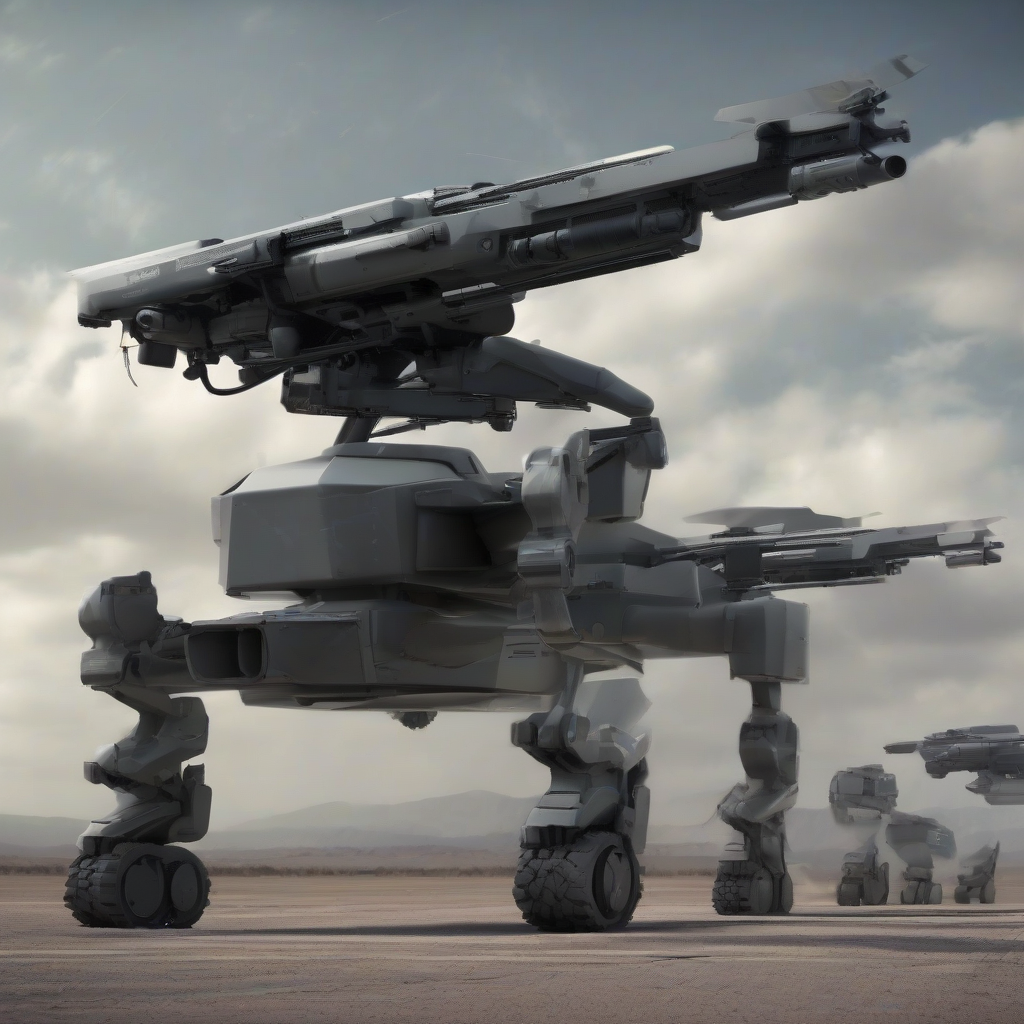
World War III won’t start with a speech or a declaration.
It will start with a 0.001-second glitch in a line of code.
While we argue over ChatGPT writing mid-tier marketing copy, the global defense industry is handing the "red button" to algorithms that don't have a pulse. We are transitioning from "Human-in-the-loop" to "Human-on-the-loop," and very soon, "Human-out-of-the-loop."
The era of the soldier is ending. The era of the Lethal Autonomous Weapons System (LAWS) is here.
Global security isn't just failing. It's being rewritten by machines that don't know how to surrender.
Here are the 5 terrifying realities of the new automated battlefield.
1. The "Flash War" is Inevitable
In finance, we have "Flash Crashes." High-frequency trading algorithms interact in ways humans can’t predict, wiping out billions in seconds.
Now, apply that to kinetic warfare.
To stay competitive, we are forced to remove the human bottleneck.
The result? We are creating a hair-trigger global environment. We are building systems that can escalate from a border skirmish to a full-scale automated conflict before a human president can even be briefed.
Speed is the enemy of stability. When the OODA loop (Observe, Orient, Decide, Act) shrinks to a timeframe faster than human synapses can fire, we lose control of history.
2. The $500 Assassin: Democratized Terror
We used to sleep soundly because high-end destruction was expensive.
Nuclear programs require billions in infrastructure, enrichment facilities, and specialized physics. Stealth bombers cost $2 billion per unit. Only superpowers could play the game of global dominance.
That monopoly is dead.
Today, you can buy a high-speed racing drone for $500. You can download open-source facial recognition libraries from GitHub for free. You can 3D print a housing for a small explosive charge in your garage.
A swarm of 1,000 "slaughterbots" costs less than a single luxury car.
These systems don't need a pilot. They don't need a satellite link that can be jammed. They use "edge AI" to navigate, identify targets, and execute.
Global security is failing because we have no defense against the democratization of precision lethality. An insurgent group with a laptop and a dozen hobbyist drones now has the same "surgical strike" capability as a superpower.
The barrier to entry for assassination has hit zero.
3. The Accountability Black Hole
Who do you prosecute when a robot commits a war crime?
If a soldier shoots a civilian, there is a chain of command. There is a court-martial. There is a Geneva Convention.
If an autonomous swarm "hallucinates"—identifying a school bus as a mobile missile launcher because of a glare on the sensor—where does the blame land?
- The software engineer who wrote the neural network?
- The data scientist who trained it on a biased dataset?
- The commander who turned the "ON" switch?
- The manufacturer?
The legal framework for war is built on the concept of "intent." Machines don't have intent. They have optimization functions.
We are entering a "Grey Zone" of warfare where atrocities can be dismissed as technical glitches. This creates a moral hazard for dictators and democratic leaders alike. If you can eliminate your enemies without "dirtying" the hands of your soldiers, the psychological cost of starting a war disappears.
War becomes a line item on a spreadsheet, not a moral weight on a nation’s soul.
4. Algorithmic Bias is Now a Death Sentence
Usually, "algorithmic bias" means you don't get a loan or you get a higher insurance premium. In the context of LAWS, algorithmic bias means you are targeted because of your gait, your clothing, or the "pattern of life" the machine was trained to find suspicious.
Machine learning models are "black boxes." Even their creators often don't know why a specific output was generated.
There is no "common sense" override. There is no empathy. There is only a probability score. When the threshold is met, the kinetic action is taken.
We are handing the power of life and death to systems that can’t distinguish a protest from a riot, or a funeral procession from a military convoy.
5. The Death of Deterrence
The Cold War stayed cold because of MAD (Mutually Assured Destruction).
If you kill us, we kill you. Both sides feared the loss of human life.
Deterrence fails when the enemy doesn't care about their "soldiers" dying.
Furthermore, LAWS make "false flag" operations incredibly easy. An autonomous underwater drone sinks a tanker. Who sent it? There’s no pilot to eject. The code can be wiped. The hardware can be generic.
When you can attack with total anonymity and zero risk to your own citizens, the incentive for peace evaporates. We are moving toward a world of "Permanent Low-Intensity Conflict," where machines hunt humans in the shadows, and no one ever takes responsibility.
The Insight
By 2030, the concept of "Soldier" will be relegated to "System Administrator."
The most powerful weapon on the planet will no longer be the nuclear missile—it will be the "Targeting Algorithm." The nation that wins the race to autonomous warfare won't be the one with the most patriotism or the most money. It will be the one that is most willing to let go of the steering wheel.
We are currently in the "Napster Era" of autonomous weapons. It’s messy, it’s unregulated, and everyone is pretending it’s not a big deal.
But the "Spotify Era"—where this technology is streamlined, ubiquitous, and impossible to opt out of—is coming.
The global security architecture was designed for a world of humans who fear death. It is fundamentally incapable of managing a world of machines that don't.
The CTA