Why Your "Healthy" Oil Is Failing: 3 Reasons You’re Doing Fat Wrong
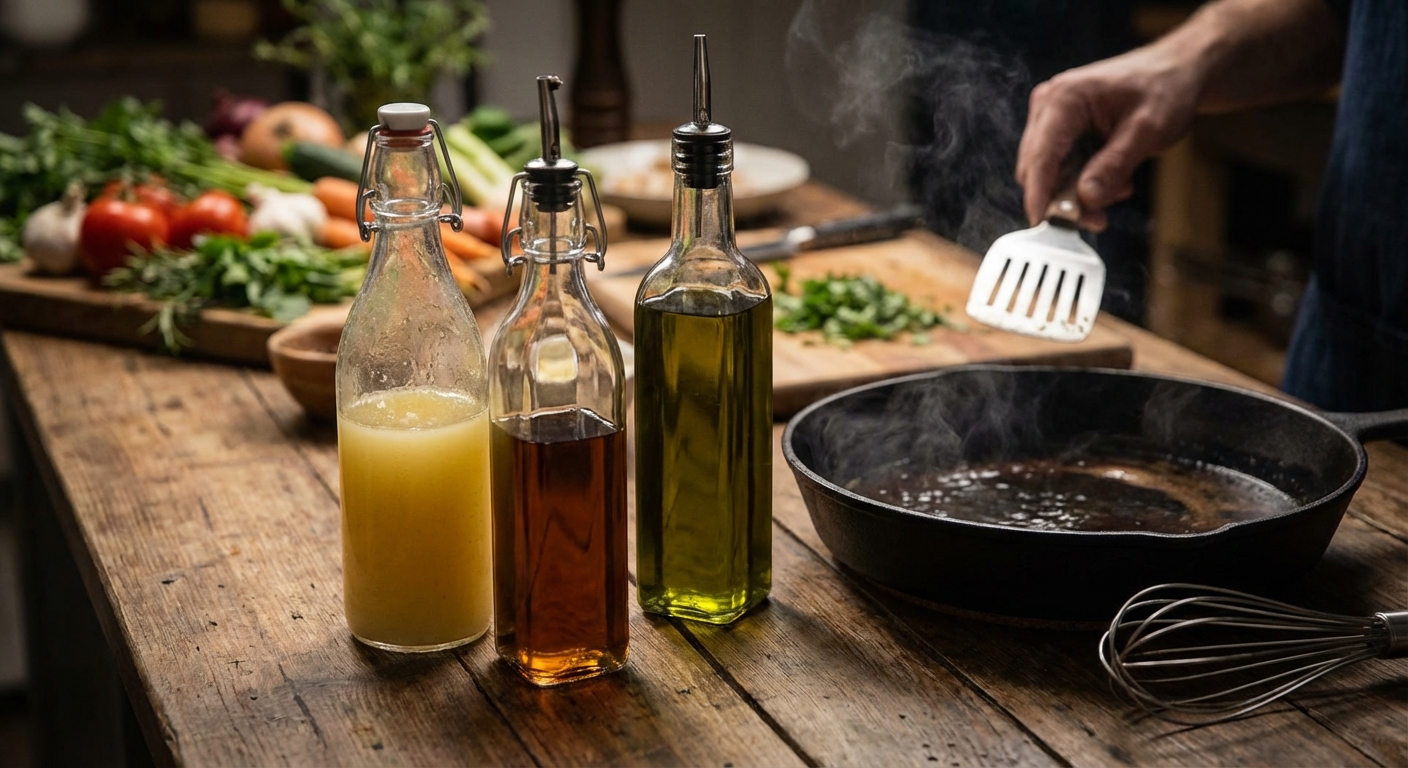
Stop buying "neutral" oils.
You don't need a high smoke point. You need a stable molecule.
I spent $500 on premium, designer oils last year. Here is what I learned: 90% of what we call "healthy" is rancid sludge in a pretty bottle.
The best fats are the ones the industry hates. Saturated. Unrefined. Heavy.
If you are choosing an oil based on a "Smoke Point" chart you found on Pinterest, you are failing your biology.
Here is why your healthy oil is actually making you sick.
1. The "Smoke Point" is a Marketing Scam
We’ve been told the same lie for thirty years: "Don't cook with Extra Virgin Olive Oil. It has a low smoke point. It turns toxic at high heat."
This is scientifically backwards.
Smoke point is a physical measurement of when an oil starts to visibly smoke. It is not a measurement of chemical stability.
I looked at the data from the 2018 Australian study that tested 10 different cooking oils. They heated them to 464°F and held them there.
The result? Extra Virgin Olive Oil was the most stable.
Even though it "smoked" earlier than canola or grapeseed oil, it produced the fewest polar compounds. Polar compounds are the actual toxins that cause inflammation and DNA damage.
Seed oils have high smoke points because they are chemically refined. They are "dead" before they hit the pan. They don't smoke because the volatile nutrients have already been stripped away by hexane and high-heat deodorizers.
Extra Virgin Olive Oil has a low smoke point because it is "alive." It is full of antioxidants like polyphenols and Vitamin E. These aren't just for your heart—they act as "bodyguards" for the fat. When you heat EVOO, the antioxidants sacrifice themselves to protect the fat from oxidizing.
If you’re using refined "light" olive oil or avocado oil because you're afraid of smoke, you are choosing a stable-looking oil over a truly stable molecule.
2. Your "Healthy" Oil is Likely a Counterfeit
The olive oil industry is closer to the drug trade than the food industry.
In 2010, UC Davis found that 69% of imported "Extra Virgin" olive oil sold in US grocery stores failed the standard. They weren't extra virgin. Most were diluted with cheap soybean or sunflower oil.
It’s even worse for avocado oil.
A 2020 study found that 82% of avocado oil samples were either rancid before their expiration date or adulterated with other oils. Some "100% Avocado Oil" bottles contained zero avocado oil.
You think you’re buying monounsaturated bliss. You’re actually buying a bottle of inflammatory Omega-6 seed oil with a green label.
I stopped buying oil from big-box retailers. I stopped looking for the "Best Value" price.
If your olive oil doesn't have a harvest date—not an expiration date, a harvest date—it's fake. If it doesn't make the back of your throat sting (that's the oleocanthal, a natural anti-inflammatory), it's dead.
You aren't saving money by buying the $12 gallon of "Italian" oil. You are paying for the privilege of consuming industrial waste.
3. You Are Poisoning the Fat in Your Own Kitchen
Even if you buy the best oil in the world, you are probably ruining it before it touches the pan.
Fat has three enemies: Light. Heat. Oxygen.
Look at your kitchen counter. Is your oil in a clear glass bottle? It’s already oxidizing. Light photons hitting that glass are breaking down the chemical bonds of the fat.
Is it sitting next to your stove? Every time you preheat the oven, you are cooking the oil inside the bottle. You are creating a "pre-rancid" product.
Is it in a plastic bottle? Heat and acidity cause the plastic to leach endocrine-disrupting chemicals directly into the fat.
I used to keep a massive 3-liter tin of olive oil. I thought I was being efficient. I was actually feeding myself peroxide. By the time I got to the bottom of the tin, the oil had been exposed to oxygen for three months. It smelled like old crayons.
That "crayon" smell isn't just a bad scent. It's the smell of lipid peroxidation. It’s the smell of a fat that is ready to damage your cell membranes.
Buy small bottles. Buy dark glass. Store them in a cool, dark cupboard. Use them within 30 days of opening.
The Insight: The "Neutral Oil" Era is Ending
Everyone is obsessed with "neutral" flavors. This is the ultimate red flag.
In nature, healthy fats have a flavor. Butter tastes like cows. Olive oil tastes like grass and pepper. Coconut oil tastes like the tropics.
If an oil is "neutral," it means it has been processed to death. The "neutrality" is the absence of life.
My prediction: The next five years will see a massive "Fat Reversion." We will stop looking for the next "superfood" oil like algae or walnut and go back to the fats our ancestors used for 5,000 years.
We will realize that the "seed oil" revolution was a 60-year experiment that failed. We will return to fats that are minimally processed, high in saturated or monounsaturated bonds, and stored in opaque containers.
The most "boring" fats are the ones that keep you alive. Suet. Ghee. Cold-pressed EVOO.
Stop trying to find a fat that "disappears" in your cooking. If you can't taste the oil, you shouldn't be eating it.
What’s the one oil you’ve always been told is healthy, but you secretly hate the taste of?