3 Reasons AI Copyright Is Failing: Why You’re Doing It Wrong
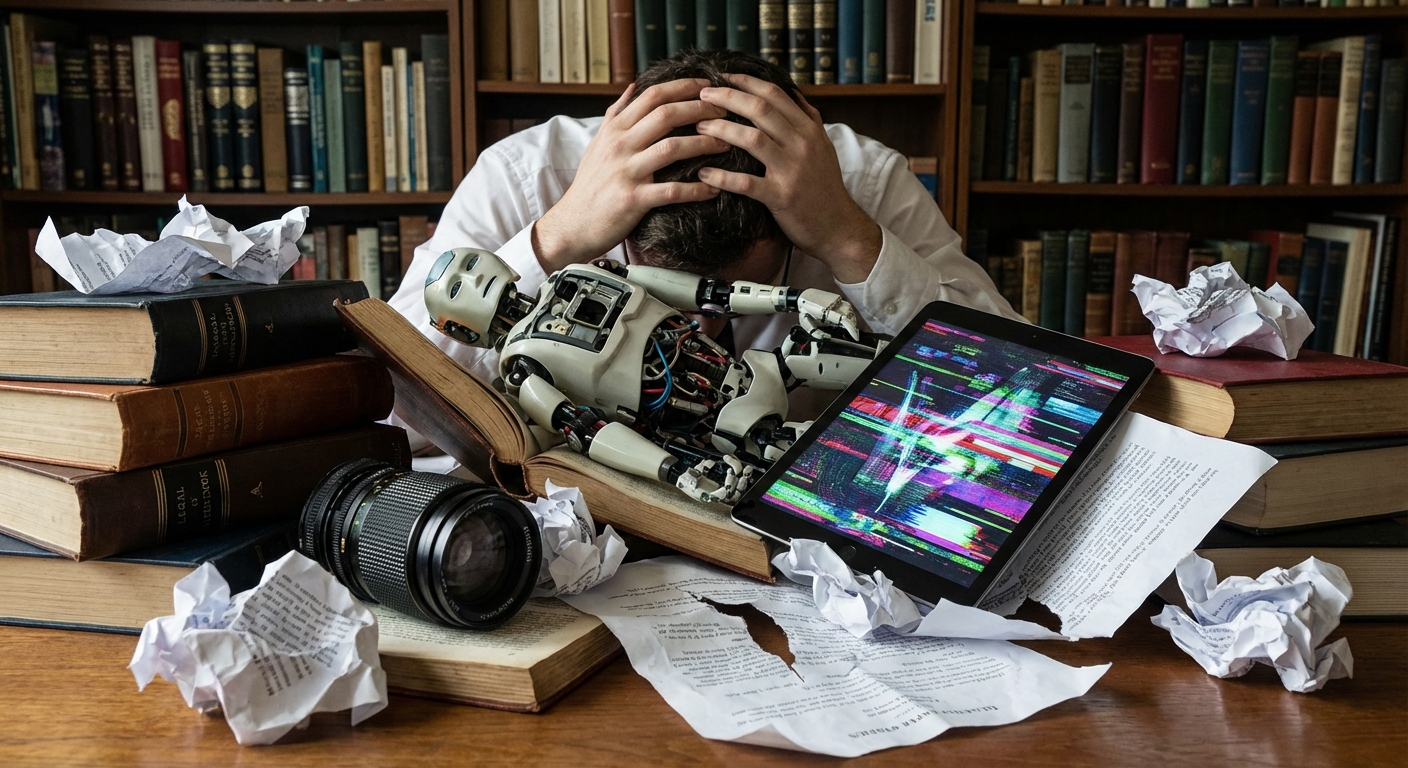
I have watched founders build entire companies around AI-generated assets. I have seen creators post “Copyright 2024” on images a bot made in three seconds. They are all building on sand.
The legal system isn’t slow. It is clear. You are just ignoring it.
I spent the last year tracking IP litigation and talking to the lawyers who actually draft these filings. Here is the reality: your prompts are worthless. Your "edits" are invisible. Your brand has zero protection.
1. The "Prompting is Art" Delusion
You think your 100-word prompt is a masterpiece of creative direction. The U.S. Copyright Office thinks it’s a grocery list.
When you tell a taxi driver to go to the airport, you didn't drive the car. You didn't choose the lane changes. You didn't manage the throttle. You gave an instruction. You are the passenger.
Copyright requires "human authorship." This isn't a vibe. It is a legal threshold.
The machine makes the expressive choices. It decides the brushstrokes. It calculates the lighting. It chooses the pixel placement. If the machine makes the "expressive" decisions, the machine is the creator. But machines cannot hold copyright.
The result? The output belongs to everyone. It is public domain the moment it hits your screen.
I see people selling "AI Prompt Engineering" courses for $2,000. They are selling you a way to be a better passenger. They are not teaching you how to own the car. If your entire value proposition is a prompt, you have no moat. Anyone can reverse-engineer your "style" in minutes. You are subsidizing the public domain with your subscription fees.
2. The "Human-in-the-Loop" Lie
"I edited the image in Photoshop. Now it’s mine."
Wrong.
The legal standard is "de minimis." If the core of the work is AI-generated, minor human tweaks don't magically grant you ownership of the whole.
I followed the Zarya of the Dawn case closely. The author used Midjourney for the images. She arranged them. She wrote the text. She edited the layout. The Copyright Office revoked her protection for the images. Why? Because she didn't control the "specific output."
If you take a public domain photo of the Mona Lisa and put a digital mustache on it, you own the mustache. You do not own the Mona Lisa.
Most of you are putting mustaches on bots.
3. The Scale Problem is a Death Trap
Companies are scaling content at a rate the law was never meant to handle.
You think you are winning because you are publishing 50 articles a day. You think you are "beating the system." You are actually creating a massive legal debt.
Traditional copyright was built for scarcity. It takes a human months to write a book. It takes years to paint a gallery. The law can handle that volume.
The law cannot—and will not—protect a trillion tokens generated by a server farm in Nevada.
We are moving toward a "Copyright Winter." The courts are already leaning toward a "Pro-Human" default. They see the flood coming. Their only lever to stop the devaluation of human labor is to deny protection to machine-made work.
I’ve talked to "AI Publishers" who are terrified. They realized their "content moat" is actually a public park. They have no "Stop" button for the copycats. They are realizing that scale without ownership is just noise.
The Insight: The Shift from Protection to Provenance
Here is what nobody is telling you: Copyright is becoming a vanity metric.
In the next 24 months, "Copyrighted" will matter less than "Authentic."
We are entering the era of Proof of Personhood. The value won't be in the image itself—images are now a commodity with a price of zero. The value will be in the receipt that a human sat in a room and bled for the work.
We are going back to the 1800s. We are going back to "Signed by the Artist."
The winning strategy isn't finding a way to "hack" the Copyright Office. It’s creating a brand where the audience cares that you made it. People don't buy Rolexes because they tell time better. They buy them because of the human craft behind them.
The smart money is moving away from "AI-Generated" and toward "AI-Augmented Human Craft." Use the bot for the research. Use it for the outline. But if you don't put the "Human" back into the final expressive layer, you are just a curator of public property.
Stop trying to own the output. Start owning the process.
The law isn't going to change to fit your workflow. You have to change your workflow to fit the law.
Are you building a brand, or are you just renting pixels from a bot?