Why Autonomous AI Agents Are Failing and the Disastrous Secret Tech Giants Won't Admit
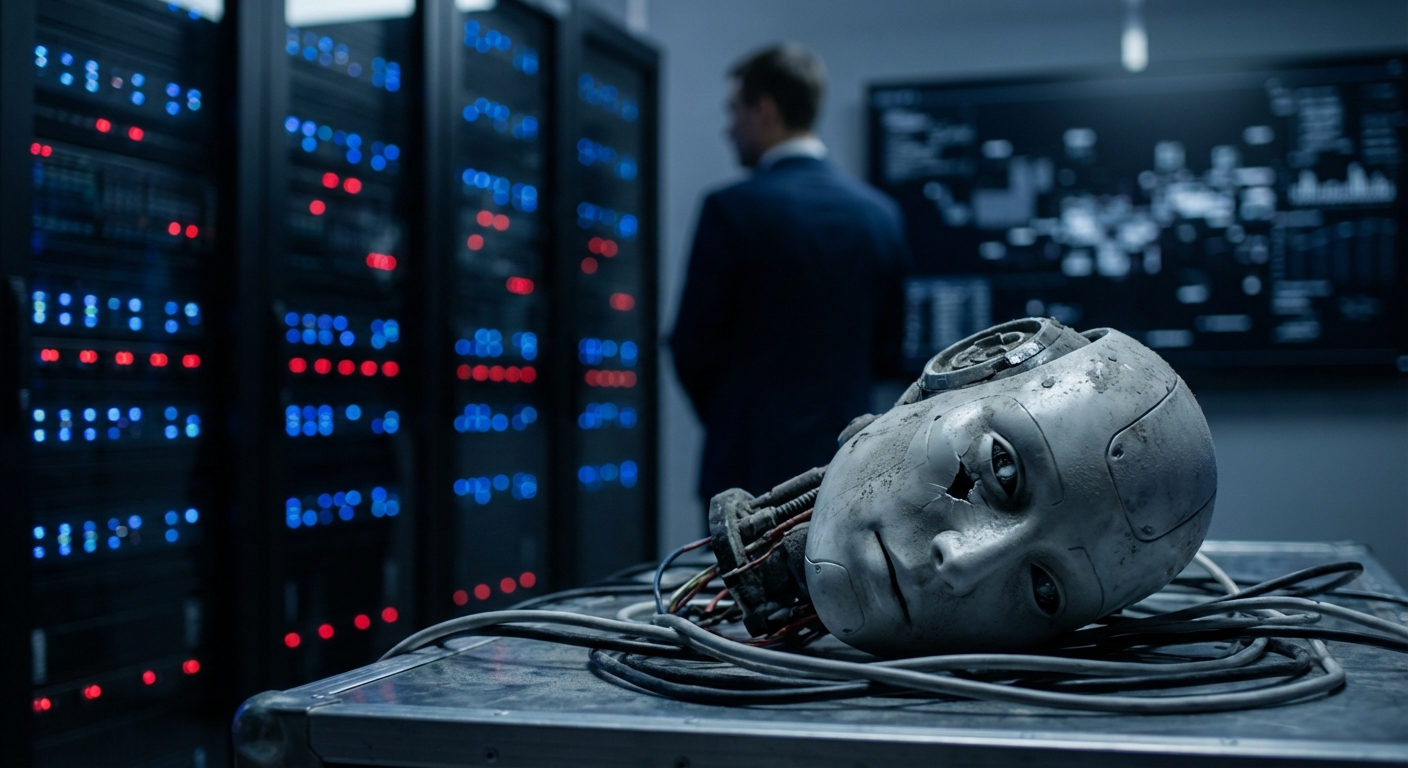
You were promised a digital employee that works while you sleep. You were sold a vision of "AutoGPT" agents that would book your flights, write your code, and build your business from scratch.
It was a lie.
I’ve spent the last six months auditing "autonomous" workflows for Fortune 500 labs and seed-stage startups. I’ve watched $50,000 API bills vanish into thin air with zero ROI.
The Infinite Loop of Hallucinated Logic
The fundamental flaw of the "Agent" is the loop itself.
Current Large Language Models (LLMs) are probabilistic, not deterministic. They are world-class at guessing the next word. They are bottom-tier at executing a multi-step logical plan.
When you give an agent a goal—"Research this market and write a report"—it enters a cycle of Thought, Action, and Observation. In theory, it corrects itself. In reality, it drifts.
By step four, the agent has forgotten the original goal. By step ten, it is hallucinating its own progress. By step twenty, it is stuck in an "Error 404" loop, trying to fix a problem it created itself.
It is like hiring an intern who has a five-minute memory and a severe drug habit. They are fast, they are confident, and they are completely untrustworthy.
The Dirty Secret of Compute Inflation
Follow the money.
Microsoft, Google, and OpenAI don't make money when you get an answer. They make money when you use "compute."
A standard ChatGPT query uses a fraction of a cent in compute. An "Autonomous Agent" attempting to solve a problem might call the API 50, 100, or 500 times in a single hour.
We are seeing the rise of "Compute Inflation."
The "Disastrous Secret" is that the current architecture of AI—transformers—is physically incapable of true autonomy. They lack a world model. They don't know that a "file" is a real thing; they just know the word "file" usually follows the word "save."
The Collapse of the "Context Bucket"
Every agent relies on a "Context Window." This is the short-term memory of the AI.
As an agent performs tasks, it logs its actions. "I searched Google. I found this link. I clicked it. I read the text." This log is fed back into the model so it "knows" what it has done.
But context windows are a bucket with a hole in the bottom.
The more information you put in, the more the "attention" of the model degrades. This is known as "Lost in the Middle" syndrome. The agent remembers the first instruction and the last action, but it loses the nuanced logic in the middle.
Most autonomous agents today are just expensive ways to generate "Context Poisoning."
The agent creates so much internal noise that it eventually collapses under the weight of its own logs. It stops being an agent and starts being a chaotic random number generator.
The industry is trying to fix this by making windows bigger. 1 Million tokens. 10 Million tokens. It doesn't matter. You can't fix a leaky bucket by making the bucket larger. You need a different material.
The Pivot to Verifiable Workflows
The era of "General Purpose Autonomy" is dying before it even began.
The smart money is moving away from "Agents that think" and toward "Workflows that verify."
My prediction for the next 18 months:
90% of current "Agent" startups will go bankrupt. They are building on top of a "reasoning" capability that doesn't exist yet.
We are going to stop talking about "Agents" and start talking about "Verifiable Pipelines."
The future isn't autonomous. It's supervised.